




Article: What Is a Champagne Diamond? Everything You Need to Know
What Is a Champagne Diamond? Everything You Need to Know

WHAT IS A CHAMPAGNE DIAMOND?
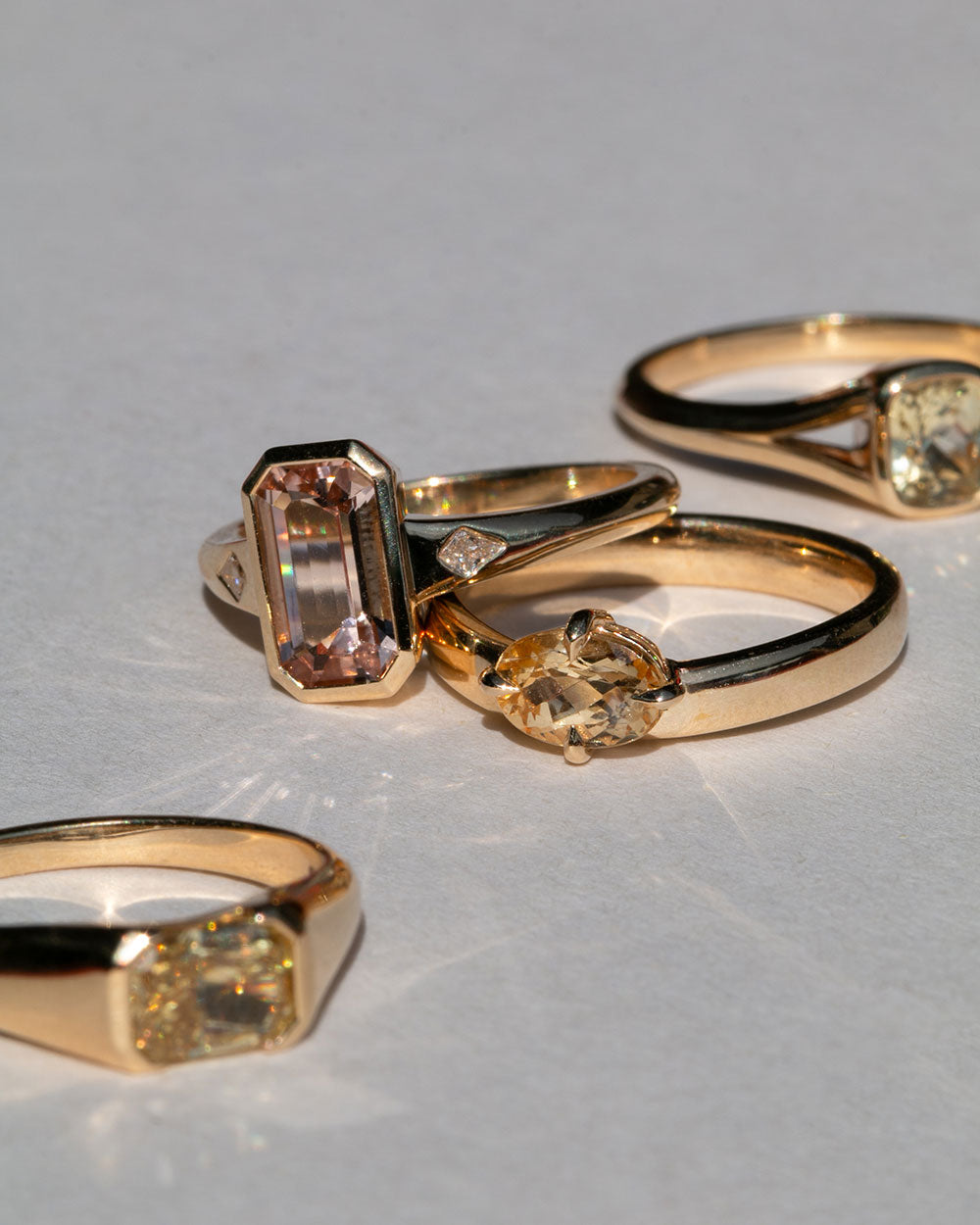
Warm, earthy and quietly distinctive, champagne diamonds have become one of the most sought-after alternatives to traditional white diamonds. Their soft honey, caramel and cognac tones offer a more understated kind of beauty, making them a favourite for bespoke engagement rings and modern heirlooms.
Yet despite their growing popularity, champagne diamonds are often misunderstood.
Can you buy a lab-grown champagne diamond? What does C3 or C5 actually mean? Why do some diamonds have GIA colour grades while others are described using the Argyle scale?
This guide explains everything you need to know.
A champagne diamond is a natural brown diamond with warm golden, honey or cognac undertones.
Like all natural diamonds, they formed deep within the Earth over billions of years. Their distinctive colour develops naturally during formation through changes within the crystal structure, creating shades that range from the palest champagne to rich chocolate brown.
Unlike traditional white diamonds, where less colour is generally considered more valuable, champagne diamonds are celebrated because of their colour.
Each stone is entirely individual, with subtle variations that make every diamond unique.

WHERE DOES THE NAME "CHAMPAGNE DIAMOND" COME FROM?
The term Champagne Diamond was popularised by the famous Argyle Diamond Mine in Western Australia.
During the 1980s, Argyle introduced the name as a more elegant way to describe naturally brown diamonds, alongside a grading system that classified their colour from C1 to C7.
Although the Argyle Mine closed in 2020, its terminology is still widely recognised throughout the jewellery industry.
It's important to note that "champagne" is a trade name, not an official gemmological colour grade.
HOW ARE CHAMPAGNE DIAMONDS GRADED?
This is where many customers become confused.
There are two different grading systems, and they are often used interchangeably.
1. The Argyle C1-C7 Scale
Developed specifically for natural champagne diamonds.
|
Grade |
Appearance |
|
C1 |
Very light champagne |
|
C2 |
Soft champagne |
|
C3 |
Medium champagne |
|
C4 |
Rich champagne |
|
C5 |
Deep champagne |
|
C6 |
Cognac |
|
C7 |
Dark cognac |
Many bespoke clients refer to these grades when requesting a champagne diamond.
However, these grades only apply to natural diamonds.
2. GIA Fancy Colour Grades

The Gemological Institute of America (GIA) does not use the word "champagne" on grading reports.
Instead, GIA describes diamonds using combinations of hue, tone and saturation.
Examples include:
- Light Brown
- Brown
- Brownish Yellow
- Yellow Brown
- Fancy Light Yellow Brown
- Fancy Brown
- Fancy Deep Brown
- Fancy Vivid Yellow Brown
The GIA scale offers a more technical description of colour, whereas the Argyle system was developed specifically as a commercial way to describe natural champagne diamonds.

Images adapted from GIA colour reference charts.
ARE ALL CHAMPAGNE DIAMONDS CERTIFIED?
No.
Many champagne diamonds, particularly smaller stones, are sold without individual certificates. This isn't unusual and doesn't mean the diamond is of lower quality. Certification generally depends on the size and value of the stone rather than whether it is a champagne diamond.
CAN YOU GET A LAB GROWN CHAMPAGNE DIAMOND?
This is one of the questions we're asked most often.
The short answer is:
Not in the same way as a natural champagne diamond.
While laboratories can grow coloured diamonds, there is currently no direct equivalent to the naturally occurring Argyle champagne colour scale.
Many suppliers may describe lab-grown diamonds as:
- Brown
- Brownish Pink
- Pink Brown
- Grey Brown
- Yellow Brown
These colours can be beautiful in their own right, but they are not identical matches for natural champagne diamonds.
So if you're looking for a lab-grown C3 or C4 champagne diamond, it's important to understand that this terminology doesn't officially exist for lab-grown stones.
Instead, jewellers work with the closest available colour family.
WHY CAN'T LAB GROWN DIAMONDS MATCH NATURAL DIAMONDS EXACTLY?
Natural champagne diamonds developed over billions of years under unique geological conditions.
Lab-grown diamonds are created in controlled environments over a matter of weeks, using either High Pressure High Temperature (HPHT) or Chemical Vapour Deposition (CVD) methods.
Although these techniques can produce a wide range of colours, recreating the precise warmth and complexity of natural Argyle champagne diamonds remains difficult.

WHICH CHAMPAGNE DIAMOND COLOUR IS BEST?
There isn't one "best" champagne diamond.
It comes down to personal preference. Some clients love pale honey tones that catch the light beautifully. Others prefer richer cognac hues with dramatic warmth and depth.
In our bespoke work, many clients gravitate towards soft golden-brown diamonds that balance warmth with brightness, offering enough light return to remain lively while retaining their distinctive character.
ARE CHAMPAGNE DIAMONDS GOOD FOR ENGAGEMENT RINGS?
Absolutely.
Champagne diamonds have become increasingly popular for engagement rings because they offer something different from traditional white diamonds while remaining timeless.
Their warm colouring pairs beautifully with:
- Recycled yellow gold
- Warm rose gold
- Mixed metal settings
- Organic, sculptural designs
- Vintage-inspired settings
They also complement a wide variety of skin tones and develop a beautifully lived-in character over time.

WHY CHOOSE A NATURAL CHAMPAGNE DIAMOND?
Natural champagne diamonds appeal to those looking for something individual.
Rather than following convention, they celebrate subtle colour, natural variation and distinctive character.
No two are ever exactly alike.
For many couples, that individuality is exactly what makes them so meaningful.
FREQUENTLY ASKED QUESTIONS
Is a champagne diamond a real diamond?
Yes. Champagne diamonds are completely natural diamonds, formed within the Earth over billions of years.
Is champagne an official diamond colour?
No. "Champagne" is a trade name popularised by the Argyle Mine. Laboratories such as GIA use descriptive fancy colour grades instead.
Can I buy a lab-grown C3 champagne diamond?
No. The Argyle C1-C7 grading system only applies to natural champagne diamonds. Lab-grown diamonds are graded using different colour descriptions.
Are champagne diamonds more affordable than white diamonds?
Often, yes. Pricing depends on colour intensity, cut, clarity and carat weight, but many champagne diamonds offer excellent value compared with colourless diamonds of similar size.
LOOKING FOR A BESPOKE CHAMPAGNE DIAMOND?
At Maya Magal, we source both natural and lab-grown diamonds for bespoke commissions.
If you're drawn to the warmth of champagne diamonds, we'll guide you through the differences between natural and lab-grown options, explain the available colour ranges, and source a stone that reflects your vision.
Every bespoke ring is handcrafted in our London studio using recycled precious metals and thoughtfully sourced gemstones, designed to become part of your story.

Written by Amy Gibson
About the Author
Amy is a goldsmith and jewellery designer with eight years of industry experience, specialising in bespoke fine jewellery, design, and goldsmithing. Her expertise spans stone setting, miniature sculpture, hand rendering and jewellery design for production. She is a qualified Goldsmith and Diamond Mounter through The Goldsmiths' Company and a Freeman of the Worshipful Company of Goldsmiths.
At Maya Magal, Amy designs and handcrafts bespoke jewellery in collaboration with clients, creating engagement rings, wedding bands and one-of-a-kind commissions with a focus on craftsmanship, wearability and lasting design.

Leave a comment
This site is protected by hCaptcha and the hCaptcha Privacy Policy and Terms of Service apply.